
New vs Old Tax Regime FY 2026-27 (AY 2027-28): Which One Saves You More Money?
Every year around HR tax declaration season, corporate Slack channels and office coffee machines buzz with the exact same headache: “Should I pick the New Tax Regime or stick with the Old one?”
If you are looking at your salary slip wondering why your in-hand salary fluctuates or how much tax will be deducted from your hard-earned bonus, you are not alone. Tax rules in India have evolved rapidly over the past couple of budgets, and what worked for your taxes two years ago might cost you thousands of rupees today if left on auto-pilot.
The good news? You don't need a finance degree or an expensive consultation to figure this out. With the official tax slabs set in Union Budget 2025-26 (and continued for FY 2026-27 / Assessment Year 2027-28), finding your ideal tax regime comes down to simple math.
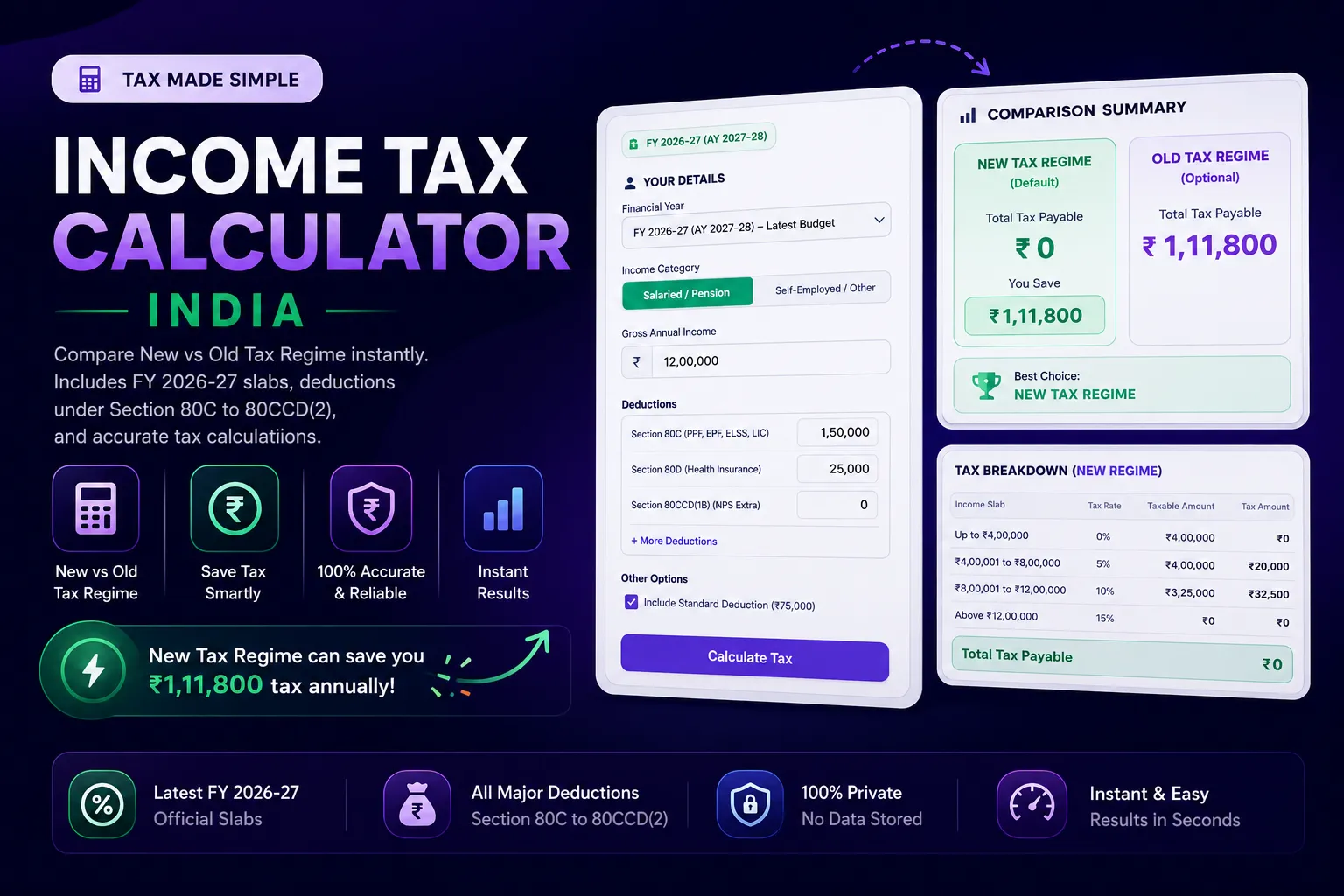
Before we dive into the calculations, if you want an instant answer tailored to your exact salary, open our free Income Tax Calculator in a new tab. It runs 100% privately in your web browser—no signups, no data logging, and no phone numbers required.
What Are the Official Income Tax Slabs for FY 2026-27 (AY 2027-28)?
To make the right choice, you first need to look at the official tax slab rates applicable for Financial Year 2026-27 (Assessment Year 2027-28).
Under current Indian tax laws, the New Tax Regime is the default regime for all individual taxpayers. However, you still retain the option to manually opt into the Old Tax Regime if it yields a lower tax liability for your specific income profile.
1. New Tax Regime Slabs (Default for All Individuals)
The New Tax Regime applies identical slab rates to all individuals, regardless of age (whether you are 25, 65, or 85 years old):
- ₹0 to ₹4,00,000: Nil (0% Tax)
- ₹4,00,001 to ₹8,00,000: 5%
- ₹8,00,001 to ₹12,00,000: 10%
- ₹12,00,001 to ₹16,00,000: 15%
- ₹16,00,001 to ₹20,00,000: 20%
- ₹20,00,001 to ₹24,00,000: 25%
- Above ₹24,00,000: 30%
Key Benefit: Salaried employees and pensioners automatically receive a flat ₹75,000 Standard Deduction under the New Regime.
2. Old Tax Regime Slabs (Optional)
The Old Tax Regime retains age-based basic exemption thresholds but features steeper tax slab jumps:
Individuals Below 60 Years:
- Up to ₹2,50,000: Nil
- ₹2,50,001 to ₹5,00,000: 5%
- ₹5,00,001 to ₹10,00,000: 20%
- Above ₹10,00,000: 30%
Senior Citizens (60 to 80 Years):
- Up to ₹3,00,000: Nil
- ₹3,00,001 to ₹5,00,000: 5%
- ₹5,00,001 to ₹10,00,000: 20%
- Above ₹10,00,000: 30%
Super Senior Citizens (Above 80 Years):
- Up to ₹5,00,000: Nil
- ₹5,00,001 to ₹10,00,000: 20%
- Above ₹10,00,000: 30%
Key Benefit: Salaried individuals receive a ₹50,000 Standard Deduction under the Old Regime, along with Chapter VI-A deductions (Section 80C, 80D, 80CCD, Section 24b, and HRA).
Quick Comparison Table: Tax Slabs FY 2026-27
| Taxable Income Range | New Regime Tax Rate | Old Regime Rate (Below 60 Yrs) |
|---|---|---|
| Up to ₹2.5 Lakhs | 0% | 0% |
| ₹2.5L to ₹3 Lakhs | 0% | 5% |
| ₹3L to ₹4 Lakhs | 0% | 5% |
| ₹4L to ₹5 Lakhs | 5% | 5% |
| ₹5L to ₹8 Lakhs | 5% | 20% |
| ₹8L to ₹10 Lakhs | 10% | 20% |
| ₹10L to ₹12 Lakhs | 10% | 30% |
| ₹12L to ₹16 Lakhs | 15% | 30% |
| ₹16L to ₹20 Lakhs | 20% | 30% |
| ₹20L to ₹24 Lakhs | 25% | 30% |
| Above ₹24 Lakhs | 30% | 30% |
New Regime vs Old Regime — Which One is Actually Better?
The fundamental difference between the two systems boils down to a classic financial trade-off:
New Tax Regime = Concessional, wider tax slabs with lower tax percentages, but zero deductions allowed (except Standard Deduction).
Old Tax Regime = Higher tax slab rates, but allows you to subtract major investments (PF, ELSS, Insurance, Home Loan Interest, HRA) from your gross income before calculating tax.
Let me walk you through three real-life scenarios to demonstrate how this plays out in practice.
Scenario 1: Rohan (Gross Annual Salary ₹8.5 Lakhs, No Major Investments)
Rohan is a 26-year-old software developer earning ₹8.5 Lakhs per year. He lives with his parents and hasn’t invested in tax-saving instruments yet.
Under New Regime:
- Gross Salary: ₹8,50,000
- Less: Standard Deduction: ₹75,000
- Taxable Income: ₹7,75,000
- Slab Tax: ₹0 (up to 4L) + 5% of ₹3.75L (₹18,750) = ₹18,750.
- Section 87A Rebate: Since taxable income is $\le ₹12,00,000$, Section 87A rebate wipes out the full tax!
- Final Tax Payable: ₹0
Under Old Regime:
- Gross Salary: ₹8,50,000
- Less: Standard Deduction: ₹50,000
- Taxable Income: ₹8,00,000
- Slab Tax: ₹12,500 (5% on 2.5L-5L) + ₹60,000 (20% on 3L) = ₹72,500 + 4% Cess = ₹75,400.
- Final Tax Payable: ₹75,400
Winner: New Tax Regime saves Rohan ₹75,400 per year!
Scenario 2: Priya (Gross Annual Salary ₹15 Lakhs, Active Investor & Rent Payee)
Priya is a marketing manager earning ₹15 Lakhs. She invests heavily in EPF and ELSS mutual funds, pays health insurance premiums for her senior citizen parents, and claims HRA.
Priya's Old Regime Deductions:
- Standard Deduction: ₹50,000
- Section 80C (EPF + ELSS): ₹1,50,000 (Max Limit)
- Section 80D (Health Insurance for Self & Parents): ₹50,000
- HRA Exemption: ₹1,50,000
- Section 80CCD(1B) (NPS): ₹50,000
- Total Deductions = ₹4,50,000
Under Old Regime:
- Taxable Income: ₹15,00,000 – ₹4,50,000 = ₹10,50,000
- Slab Tax: ₹12,500 (5% on 2.5L-5L) + ₹1,00,000 (20% on 5L-10L) + ₹15,000 (30% on 50k) = ₹1,27,500.
- Plus 4% Cess: ₹5,100
- Final Tax Payable: ₹1,32,600
Under New Regime:
- Gross Salary: ₹15,00,000 – ₹75,000 (Std Ded) = ₹14,25,000 Taxable Income
- Slab Tax: 0 (0-4L) + ₹20,000 (4L-8L) + ₹40,000 (8L-12L) + ₹33,750 (15% on 2.25L) = ₹93,750.
- Plus 4% Cess: ₹3,750
- Final Tax Payable: ₹97,500
Winner: New Tax Regime saves Priya ₹35,100 per year, even with ₹4.5 Lakhs in Old Regime deductions!
Scenario 3: Vikram (Gross Annual Salary ₹22 Lakhs with Home Loan & High HRA)
Vikram earns ₹22 Lakhs per year. He pays ₹2 Lakhs annual interest on a self-occupied home loan and claims substantial HRA.
Vikram's Old Regime Deductions:
- Standard Deduction: ₹50,000
- Section 80C: ₹1,50,000
- Section 24(b) Home Loan Interest: ₹2,00,000 (Max Limit)
- HRA Exemption: ₹2,50,000
- Section 80D: ₹25,000
- Total Deductions = ₹6,75,000
Under Old Regime:
- Taxable Income: ₹22,00,000 – ₹6,75,000 = ₹15,25,000
- Total Tax Payable (including Cess): ₹2,80,800
Under New Regime:
- Taxable Income: ₹22,00,000 – ₹75,000 = ₹21,25,000
- Total Tax Payable (including Cess): ₹3,04,200
Winner: Old Tax Regime saves Vikram ₹23,400 per year!
General Rule of Thumb: What is the Breakeven Point?
If your total allowable deductions under the Old Regime (80C + 80D + HRA + Home Loan Interest + Std Ded) exceed the threshold below for your salary bracket, the Old Regime wins. Otherwise, the New Regime wins:
- Salary up to ₹12.75 Lakhs: New Regime is almost unbeatable (Zero Tax).
- Salary ₹15 Lakhs: You need at least ₹4.25 Lakhs+ in deductions for Old Regime to win.
- Salary ₹20 Lakhs+: You need at least ₹4.75 Lakhs+ in deductions for Old Regime to win.
Understanding the ₹12 Lakh Tax-Free Limit (Section 87A Rebate)
One of the most significant headlines in Indian taxation is that income up to ₹12 Lakhs is virtually tax-free under the New Regime.
Here is how the math works under Section 87A:
If your net taxable income under the New Regime does not exceed ₹12,00,000, Section 87A provides a full tax rebate of up to ₹60,000. Because the slab tax on ₹12 Lakhs is exactly ₹60,000 (0 + ₹20k + ₹40k), the rebate brings your net tax liability straight down to ₹0.
Since salaried employees get an automatic ₹75,000 Standard Deduction: $$\text{Gross Salary } ₹12,75,000 - \text{Std Deduction } ₹75,000 = \text{Taxable Income } ₹12,00,000 \rightarrow \text{Tax Payable } = ₹0$$
What is Section 87A Marginal Relief?
What happens if your taxable income is ₹12,10,000 (just ₹10,000 above the ₹12 Lakh limit)? In older tax structures, crossing a rebate threshold by even ₹1 would trigger the full slab tax.
Under Section 87A Marginal Relief, the tax payable on your income cannot exceed the exact amount of income that crosses ₹12 Lakhs.
- Taxable Income: ₹12,10,000 (Excess over 12L = ₹10,000).
- Slab Tax before relief: ₹61,500.
- With Marginal Relief, your tax after rebate is capped at ₹10,00,000 (plus 4% Cess = ₹10,400). You don't get penalized for earning a small bonus!
How to Calculate Your Tax & Take-Home Salary on ToolWala AI
Calculating your tax liability manually takes 20 minutes of Excel spreadsheet tweaking. On our free Income Tax Calculator, it takes 5 seconds:
- Enter Your Income: Use the interactive slider or type your gross annual salary.
- Select Category & Income Type: Choose between Salaried / Pensioner or Self-Employed, and select your age group.
- Fill Old Regime Deductions: Input your Section 80C, 80D, HRA, and Section 24(b) home loan figures if you want to test the Old Regime.
- Compare Instantly: View side-by-side tax breakdowns, monthly TDS deductions, and a clear badge showing exactly how many rupees you save.
If you are planning home loan EMIs, use our companion EMI Calculator to find your exact annual interest component eligible for Section 24(b) deduction. Business owners can also use our GST Calculator to separate GST components from gross billing revenue.
4 Common Mistakes People Make When Choosing a Tax Regime
- Assuming New Regime is Always Better: While the New Regime is great for most people, high earners with active home loans and substantial HRA can still save ₹30,000 to ₹80,000 annually in the Old Regime.
- Forgetting to Recalculate After Increments: A 15% salary hike or job change can shift your breakeven threshold. Always recalculate your tax at the start of every financial year.
- Miscalculating HRA Exemption: HRA exemption is not just the total rent you pay—it is the minimum of three statutory conditions. Make sure to input the true exempted amount.
- Ignoring Monthly TDS Impact: If you select the wrong regime with your company HR in April, excess TDS will be deducted from your monthly paycheck every month. While you can claim a refund when filing your ITR, why lock up your liquidity for over a year?
Frequently Asked Questions (FAQs)
1. Can I switch between the Old and New Tax Regime every year?
Yes! If you are a salaried employee, you can switch between the New and Old tax regime every single financial year at the time of filing your Income Tax Return (ITR-1 or ITR-2). However, if you have business or professional income (ITR-3 or ITR-4), you can only switch out of the New Regime once in your lifetime.
2. Is the Standard Deduction available in both regimes?
Yes, but the amount differs. Salaried employees get a ₹75,000 Standard Deduction under the New Tax Regime (FY 2026-27) and a ₹50,000 Standard Deduction under the Old Tax Regime.
3. What happens if my taxable income is exactly ₹12 Lakhs?
If your taxable income after standard deduction is exactly ₹12,00,000 under the New Regime, your Section 87A rebate will be ₹60,000, making your net income tax payable ₹0.
4. Do senior citizens get different tax slabs in the New Regime?
No. In the New Tax Regime, the slab rates and ₹4 Lakh basic exemption limit are identical for all individuals regardless of age. Senior citizens (above 60) and Super Senior citizens (above 80) get higher basic exemptions (₹3 Lakhs and ₹5 Lakhs) only under the Old Tax Regime.
5. Is this calculator accurate for self-employed individuals and freelancers?
Yes! Simply select the Self-Employed / Business option in our Income Tax Calculator. The calculator will adjust standard deductions accordingly and compute accurate slab taxes.
Summary & Final Takeaway
Choosing the right tax regime isn't about guesswork—it's about matching your investments against the official slab thresholds.
Before you submit your investment declarations to your HR team or file your ITR, test your numbers on the ToolWala AI Income Tax Calculator. It is 100% free, updated with verified FY 2026-27 Union Budget slabs, and processes everything in your browser memory for absolute privacy.
Disclaimer: This article is for informational and educational purposes based on Income Tax Department slabs for FY 2026-27 (AY 2027-28). Tax laws are subject to amendment in future Union Budgets. Please consult a qualified Chartered Accountant (CA) or certified tax professional for individual tax planning and complex filing scenarios.